HDMI Matrix vs. AV Over IP: Which Distribution Method is Better?
Abstract: For decades, the HDMI matrix switcher has been the dependable workhorse of professional AV distribution—a fixed-port, near-zero-latency hardware solution that simply works. But as installations grow beyond 8×8, and as enterprises demand multi-site routing, USB extension, and software-defined control, AV over IP has emerged as a genuinely disruptive alternative. This article compares the two architectures across latency, scalability, cost, bandwidth, and real-world deployment scenarios, drawing on current market data and industry standards to help integrators and end users make an informed decision. The short answer: neither is universally “better.” The long answer, however, is worth reading.
Introduction: A Familiar Trade-Off, Now More Complicated
Walk into almost any corporate boardroom built before 2020, and you will likely find a rack-mounted HDMI matrix switcher quietly doing its job. It takes four, eight, or sixteen sources and routes them to an equal number of displays. It has no operating system to crash, no network configuration to troubleshoot, and no perceptible delay when someone presses a button to switch inputs.
Then walk into a modern command center or a multi-building campus deployment. You will find something quite different: a rack of encoders and decoders, a managed network switch with IGMP snooping enabled, and a software dashboard that lets an operator route any source to any display across VLANs and subnets. There is no fixed port ceiling, no dedicated cabling to every room, and no need to replace a chassis when the system grows.
These two scenarios represent the fundamental tension in professional AV distribution today. HDMI matrix switchers offer simplicity, determinism, and near-zero latency. AV over IP offers flexibility, scalability, and a path to convergence with IT infrastructure. The question is not which technology is “better” in the abstract—it is which one is better for a given application, budget, and growth trajectory.
This article will help you answer that question. We will examine both architectures across the dimensions that matter most: latency, scalability, cost, bandwidth, signal integrity, standards and interoperability, and real-world deployment complexity. We will also look at the market data—because the numbers tell a story about where the industry is heading.
What Is an HDMI Matrix Switcher?
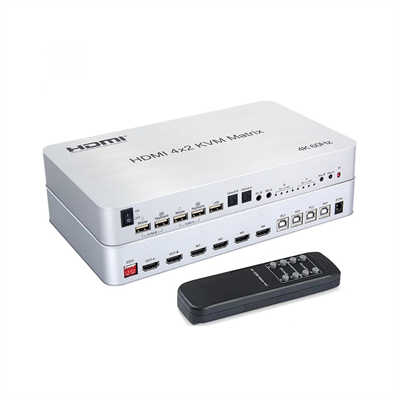
An HDMI matrix switcher is a dedicated hardware device that routes multiple HDMI input sources to multiple HDMI output displays. Unlike a simple splitter, which sends one input to many outputs, a matrix switcher allows independent routing: any input can go to any output, simultaneously, in any combination. A 4×4 matrix, for example, can connect four sources to four displays and let you send Source A to Display 1 while sending Source B to Displays 2, 3, and 4.
The architecture is fundamentally point-to-point. Each display requires a physical cable run back to the matrix chassis—whether that is a direct HDMI cable (limited to roughly 10 meters without extension), an HDBaseT link over Cat6 (typically up to 100 meters), or a fiber extender for longer distances. The matrix itself is a fixed-port device: an 8×8 switcher has eight inputs and eight outputs, and that is the end of the story. If you need a ninth display, you buy a 16×16 chassis. There is no software update that adds ports.
What the HDMI matrix does extremely well is deliver a predictable, deterministic signal path with essentially no processing delay. The switching is handled in hardware, often with seamless switching between sources. There is no compression, no packetization, and no dependence on network infrastructure. For applications where a frame of delay matters—live production, real-time control rooms, certain medical imaging workflows—this is not a minor advantage. It is the whole point.
The market reflects this enduring relevance. The global HDMI matrix switcher market was valued at approximately $1.86 billion in 2024 and is projected to reach $3.5 billion by 2035, growing at a compound annual growth rate of around 5.9%. That is not the growth curve of a dying technology. It is the growth curve of a mature, stable, and still-indispensable category.
What Is AV Over IP?
AV over IP (often abbreviated AVoIP) takes a fundamentally different approach. Instead of routing baseband HDMI signals through a dedicated switch, it encodes audio and video into IP packets and transmits them over standard Ethernet networks. The “matrix” is no longer a piece of hardware in a rack; it is the network itself.
The typical AV over IP signal chain looks like this: a source connects to an encoder (sometimes called a transmitter), which compresses or lightly processes the signal and packetizes it. The packets travel through a managed network switch—often on a dedicated AV VLAN—to a decoder (receiver) connected to a display. Routing is handled in software. To send Source A to Display 3, you update a routing table, not a physical switch matrix. To add a new display, you connect a decoder to the nearest network port and assign it an IP address. The system grows by adding endpoints, not by replacing a chassis.
This architecture unlocks capabilities that a traditional matrix cannot match. Distance is effectively unlimited—packets can be routed across buildings, campuses, or even continents. Scalability is bounded only by network capacity, not by port count. And because the signal is already in the IP domain, it can be integrated with USB extension, KVM control, audio DSP, and room control systems on the same infrastructure.
The market for AV over IP is growing substantially faster than the traditional matrix market. The global AV-over-IP market was projected at approximately $18.09 billion in 2025 and is expected to reach $694.34 billion by 2033, representing a compound annual growth rate of 57.76%. Even if that figure reflects a broad definition of the market (including software and services), the direction is unmistakable. AV over IP is where the industry is investing.
Head-to-Head Comparison: The Dimensions That Matter
Latency
This is where the two architectures diverge most sharply, and where the choice often becomes obvious.
A traditional HDMI matrix switcher operates with near-zero latency—typically well under one millisecond, because the signal is switched in hardware without encoding, compression, or buffering. For live broadcasts, real-time control rooms, or any application where a frame of delay is unacceptable, this is the gold standard.
AV over IP latency depends heavily on the protocol and codec. At the low end, SDVoE (Software Defined Video over Ethernet) achieves sub-microsecond latency by transmitting uncompressed video over 10 Gbps Ethernet networks. It effectively delivers zero latency in real-world applications, rivaling—and in some cases surpassing—traditional matrix switching. At the other end, compressed protocols like H.264 or H.265 can introduce 1–30 milliseconds of latency depending on network load and codec configuration. NDI typically runs 2–5 frames, and Dante AV delivers under 5 ms audio latency with roughly one frame of video delay.
The practical takeaway: if your application demands sub-millisecond determinism, a traditional matrix or an SDVoE-based AV over IP system will both work. If your application can tolerate a few milliseconds—and most corporate, educational, and digital signage deployments can—then compressed AV over IP protocols are entirely viable.
Scalability
A matrix switcher is fundamentally constrained by its physical port count. An 8×8 switcher has eight inputs and eight outputs. If you need more, you buy a larger chassis. The industry rule of thumb is that once matrixing needs exceed 8×8, it is worth looking seriously at AV over IP—especially if expansion is likely. At that point, a traditional matrix risks boxing the client into a solution that will limit future utility.
AV over IP scales by adding endpoints. A 10 GbE backbone typically supports 8–10 concurrent uncompressed SDVoE 4K60 streams per switch, while compressed protocols like Dante AV and NDI HX can support 50 or more streams on the same backbone. Need to add a source? Plug in another encoder. Need to add a display three buildings away? Connect a decoder to the nearest network port. There is no fixed ceiling, and no need to replace core hardware.
Cost
The cost comparison is not as simple as “matrix is cheap, IP is expensive.” It depends heavily on system size and existing infrastructure.
For small to medium deployments—say, a 4×4 or 8×8 system in a single room—a traditional HDMI matrix switcher is almost always more cost-effective. The hardware is simpler, the installation is faster, and there is no network configuration to manage. A matrix switcher in this range is a plug-and-play device.
For larger deployments, the economics shift. AV over IP leverages existing IP infrastructure, which can reduce cabling costs by up to 30% compared to traditional coaxial or HDBaseT setups, and by up to 60% on campus-scale rollouts versus matrix-and-HDBaseT topologies. The initial per-endpoint cost of encoders and decoders is higher than the equivalent matrix ports, but the ability to add endpoints incrementally—without replacing a central chassis—often makes AV over IP more economical over the system’s lifetime.
Bandwidth and Signal Integrity
An uncompressed 4K60 4:4:4 HDMI 2.0 signal demands approximately 18 Gbps of bandwidth. A traditional matrix switcher handles this natively over HDMI or HDBaseT cabling. AV over IP must either compress the signal to fit within network bandwidth constraints or dedicate a 10 Gbps link to each uncompressed stream.
SDVoE takes the uncompressed route, requiring a 10 Gbps network infrastructure and approximately 10 Gbps of dedicated bandwidth per stream. This preserves image quality perfectly but limits the number of concurrent streams per switch and demands careful network design. Compressed protocols—Dante AV, NDI, Q-SYS—fit 4K60 signals into 1 Gbps or even lower bandwidth by using visually lossless or lossy codecs. The trade-off is a small amount of compression artifact and additional latency.
For digital signage, corporate presentation, and most educational applications, compressed AV over IP delivers excellent quality at a fraction of the bandwidth. For broadcast, medical imaging, and high-end command centers, uncompressed SDVoE or a traditional matrix remains the safer choice.
Complexity and Reliability
A traditional HDMI matrix switcher is a self-contained hardware appliance. There is no network to configure, no VLANs to manage, no multicast settings to tune. If something fails, you replace the unit. Reliability is high because there are very few variables.
AV over IP introduces network complexity. You need managed switches with IGMP snooping and querier enabled, a dedicated AV VLAN, adequate multicast table capacity, and Precision Time Protocol (PTP) synchronization for frame-accurate video wall alignment. This is not insurmountable—modern AV over IP platforms are increasingly IT-friendly—but it does require IT expertise that many AV integrators did not need a decade ago. And when the network goes down, the AV system goes down with it.
Standards and Interoperability: The AV Over IP Alphabet
One of the persistent frustrations of AV over IP is the proliferation of protocols. SDVoE, Dante AV, NDI, IPMX, Q-SYS, and SMPTE ST 2110 all compete for dominance, and they do not all interoperate seamlessly.
SDVoE is the uncompressed, zero-latency standard built on 10 GbE. It is favored in broadcast, command centers, and medical imaging, where image quality and latency are non-negotiable. The SDVoE Alliance promotes it as a direct rival to matrix switch performance.
Dante AV leverages Audinate’s established Dante audio ecosystem, extending it to video with both 1 GbE compressed and 10 GbE uncompressed variants. It has seen the highest percentage growth in product numbers among AVoIP protocols and is particularly strong in corporate AV environments where Dante audio is already deployed.
NDI (Network Device Interface) leads in product numbers and is widely used in broadcast, streaming, and software-based production. NDI HX compresses signals to 100–200 Mbps, making it suitable for bandwidth-constrained environments.
IPMX (Internet Protocol Media Experience) is the open-standards contender, developed by the Alliance for IP Media Solutions (AIMS) and the Joint Taskforce on Network Media. It is designed to be a common language for AV over IP, drawing on SMPTE ST 2110 and AES67. IPMX 2.0 is in draft and is planned to natively support NDI 7’s 8K transport and Dante AV’s audio embedding.
For integrators, the practical implication is that protocol choice matters. A system built on SDVoE will not natively talk to an NDI device without a gateway. A mixed-protocol environment is possible, but it adds complexity. The industry is moving toward interoperability—IPMX is a significant step in that direction—but we are not there yet.
Real-World Use Cases: Where Each Architecture Wins
Where HDMI Matrix Switchers Still Make Sense
Corporate boardrooms and huddle rooms. A fixed 4×4 or 8×8 matrix in a single room is simple, reliable, and cost-effective. There is no network dependency and no configuration overhead. When the meeting starts, the system works.
Retail showrooms and digital signage. Retail environments often use a small number of sources feeding a handful of displays. A matrix switcher handles this without the complexity of an IP infrastructure. Restaurants, hotels, and retail chains commonly deploy 4×4 or 8×8 matrices for menu boards and promotional displays.
Control rooms with fixed layouts. Some control rooms have a stable set of sources and displays that rarely change. A matrix switcher with seamless switching and zero latency is a natural fit, particularly when the system does not need to scale.
Temporary installations. Trade shows and event venues often need quick, reliable AV distribution without touching the network. An HDMI matrix and a few Cat6 runs can be set up in minutes.
Where AV Over IP Is the Right Call
Multi-building campuses and enterprises. When AV distribution spans more than one room, floor, or building, AV over IP is almost always the answer. The network becomes the matrix, and routing is handled in software. Corporate offices with lobbies in multiple cities can manage all displays from a single dashboard.
Large-scale video walls and command centers. An AV over IP matrix handles any-to-any switching across dozens or hundreds of endpoints through software, without the rack space and cost of a large hardware matrix. Video wall processing, multiview outputs, and seamless scaling can be integrated directly into the SDVoE ecosystem, reducing the number of discrete devices required.
Stadiums, arenas, and entertainment venues. Distributing live feeds, advertisements, and replays across hundreds of screens is impractical with a traditional matrix. AV over IP scales to this level by leveraging the venue’s network infrastructure.
Hybrid and remote production. AV over IP can stream 4K content across continents with low latency via SRT Gateway technology, making it suitable for international teams and remote production workflows.
The Decision Framework: A Practical Checklist
If you are standing at the beginning of a project and trying to decide between an HDMI matrix and AV over IP, here is a practical framework.
Choose an HDMI matrix switcher if:
- Your matrixing needs are 8×8 or smaller, and unlikely to grow significantly.
- You need sub-millisecond latency and deterministic switching.
- You want a simple, self-contained system with minimal IT involvement.
- Your displays are within 100 meters of the source, or you are willing to use HDBaseT extenders.
- Your budget is constrained, and the system will not need to scale.
Choose AV over IP if:
- Your matrixing needs exceed 8×8, or expansion is likely.
- You need to distribute AV across multiple rooms, floors, or buildings.
- You want to integrate USB, KVM, audio, and control on the same infrastructure.
- You are comfortable with—or have access to—managed network infrastructure and IT expertise.
- You want software-defined routing and centralized management.
- Your deployment is large enough that the per-endpoint cost of encoders and decoders is offset by reduced cabling and incremental scalability.
There is also a middle path: SDVoE-based AV over IP combines zero-latency performance with IP scalability, making it the closest thing to a “best of both worlds” solution for applications that need both matrix-grade latency and IP-grade flexibility. The trade-off is a 10 Gbps network requirement and a higher initial infrastructure investment.
Conclusion: The Question Is Not “Which Is Better,” But “Which Is Right”
The HDMI matrix switcher and AV over IP are not competitors in a zero-sum game. They are tools for different jobs, and the most successful AV deployments often use both—a matrix in the boardroom, IP for the campus-wide signage and control room.
What is clear from the data is that AV over IP is where the growth is. The AV-over-IP market is expanding at a rate that the traditional matrix market cannot match, and the protocol ecosystem—SDVoE, Dante AV, NDI, IPMX—is maturing rapidly. At the same time, the HDMI matrix market continues to grow steadily, driven by the persistent need for simple, reliable, low-latency distribution in small and medium spaces.
The right answer depends on the specifics of your project: the number of endpoints, the distance between them, the latency tolerance, the existing infrastructure, and the client’s appetite for network complexity. As a rule of thumb, once your matrixing needs exceed 8×8, it is worth looking very seriously at AV over IP—especially if expansion is likely. Below that threshold, a traditional matrix switcher remains one of the most dependable and cost-effective tools in the AV integrator’s kit.
Neither technology is obsolete. Neither is universally superior. The skill lies in knowing which one to reach for—and when to combine both.
Frequently Asked Questions
Can AV over IP match the zero-latency performance of an HDMI matrix?
Yes, but only with specific protocols. SDVoE achieves sub-microsecond latency by transmitting uncompressed video over 10 Gbps Ethernet, which is effectively zero latency in real-world applications. Compressed protocols like H.264, H.265, NDI, and Dante AV introduce latency in the range of 1–30 milliseconds, which is acceptable for most corporate and signage applications but not for live production or real-time control.
Is AV over IP more expensive than an HDMI matrix?
For small systems (8×8 or less), yes—AV over IP has a higher initial cost per endpoint because it requires encoders, decoders, and managed network infrastructure. For larger deployments, AV over IP can be more cost-effective because it leverages existing IP cabling and scales incrementally without replacing a central chassis. Cabling cost reductions of 30–60% have been reported on campus-scale rollouts compared to traditional matrix and HDBaseT topologies.
Do I need a 10 Gbps network for AV over IP?
It depends on the protocol. SDVoE requires a 10 Gbps network for uncompressed 4K60 streams, with approximately 10 Gbps per stream. Dante AV, NDI, and Q-SYS can operate on 1 Gbps networks by using visually lossless or compressed codecs. A 10 GbE backbone typically supports 8–10 concurrent uncompressed SDVoE 4K60 streams per switch, while compressed protocols support 50 or more streams on the same backbone.
Can I mix HDMI matrix and AV over IP in the same system?
Yes, and many integrators do. A common approach is to use a traditional matrix for a fixed, latency-sensitive room (such as a boardroom or control room) and AV over IP for campus-wide distribution, digital signage, or multi-room audio. The two systems can operate independently or be bridged with a gateway or matrix output that feeds an AV over IP encoder.
Which AV over IP protocol should I choose?
It depends on your priorities. Choose SDVoE for uncompressed, zero-latency performance in broadcast, command centers, and medical imaging. Choose Dante AV if you are already invested in the Dante audio ecosystem and want a unified AV+audio infrastructure. Choose NDI for broadcast, streaming, and software-based production workflows. Choose IPMX if you want an open, standards-based platform with long-term interoperability across multiple protocols. There is no single “best” protocol—only the one that fits your application.
What happens to my AV over IP system if the network goes down?
If the network goes down, the AV distribution goes down with it. This is the fundamental trade-off of IP-based AV. Traditional matrix switchers are self-contained and do not depend on external network infrastructure. For mission-critical AV over IP deployments, redundancy is essential: dual-NIC encoders and decoders, redundant switch fabric, and dedicated AV VLANs with quality-of-service (QoS) prioritization. Many integrators recommend keeping a small matrix switcher as a fallback for critical rooms.
Published: 2026 | Categories: Pro AV, Signal Distribution, AV over IP | Reading Time: 18 minutes
📖 Related Featured Articles

Using a 2x2 HDMI Matrix for Dual Monitor Productivity: A Practical Guide
Learn how a 2x2 HDMI matrix switch can streamline your dual monitor workflow. Covers productivity da...

How to Set Up a 4x4 HDMI Matrix for a Home Automation System
Learn how to set up a 4x4 HDMI matrix for your home automation system. This guide covers hardware se...

HDMI Matrix for Art Installations and Museums: A Complete Technical Guide
How museums and art installations use HDMI matrix switchers for 4K video distribution, video walls, ...

What Is an HDMI Matrix? The Ultimate Flexibility for Multi-Screen Setups
A complete guide to HDMI matrix switchers: how they work, how they differ from splitters and switche...